I left Omaha late last night with one thought on my mind: two days in Omaha is one day too many. 24 hours would have been fine. Perhaps I would have had a different opinion if I hadn’t been carrying my luggage around in 80 degree weather, but there’s just not that much there for tourists.
The main reason I stopped in Omaha in the first place was to break up the train journey between Chicago and Denver, and Omaha was one of the few places in between where I could imagine spending any time at all.
That said there’s a few attractions I skipped out on because they seemed oriented more towards kids, namely the Durham Museum and the Omaha Zoo.
It’s a shame because I think there’s some interesting regional history adults might enjoy in a museum setting. I mean the place was bombed by Japan and all they have to show for it is one lousy plaque? Come on, guys.
I think my favorite part of visiting Omaha was a chance to spend time walking along the Missouri River. It’s a very fast moving river and quite the sight to behold. Just wouldn’t want to be there when it floods.
There are a few spots to see on the Omaha side of the Missouri River, all of which are connected via a pedestrian/bike trail. It’s a bit of a hike; there’s a very reasonably priced bike share program in Omaha that you may wish to take advantage of if you choose to visit these locations.
Just south of Old Town is a campus of buildings primarily housing offices of food conglomerate Conagra Brands. East of those buildings is Heartland of America Park which has an enormous lake with a water feature in the center, which continuously sprays water straight up into the sky at alternating heights. When it reaches its highest peak the wind tends to sweep mist across the park — a refreshing treat on a hot sunny day.
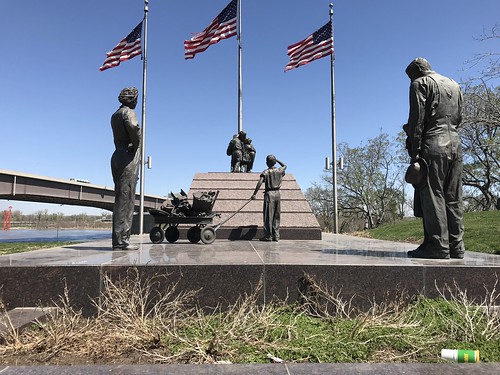
Heading north through the park there’s a series of World War II memorials. Even after reading the plaques I wasn’t exactly sure why these memorials were located here, they just felt… out of place?
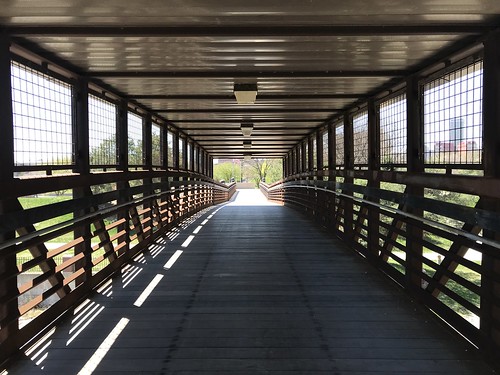
Continuing further north there’s a long wooden bridge that goes over a train line and under a freeway overpass. Some parts of the bridge feature covered sections, which are a bit redundant since the bridge itself is partly covered by the overpass. I assume this is more of an homage to America’s past than a functional aspect of the design.
On the other side of the bridge is a red and white paved area called Lewis and Clark Landing. During my visit this was partly under construction and not very active aside from some joggers using the space.
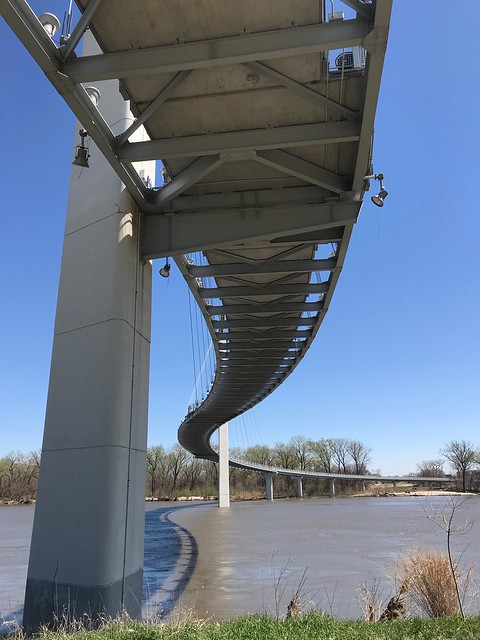
Continuing north along the path you’ll head under a curvy suspension bridge named after former Nebraska governor and senator Bob Kerrey. He’s somewhat of an albatross as a successful Democrat politician in a red state — his views on abortion seem a particularly touchy subject among the locals.
The bridge itself is only open to pedestrians and bicyclists when weather permits. So what makes the bridge interesting?
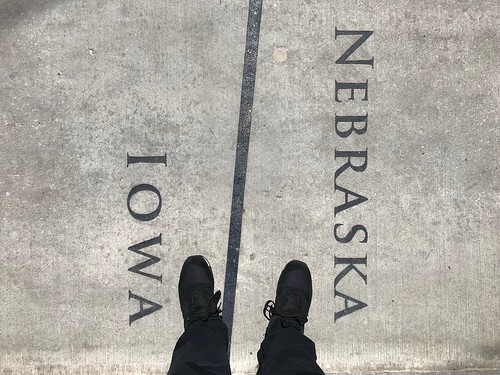
In Omaha the Missouri River is the border between Nebraska and Iowa. This is marked on the bridge’s pavement and is a popular photo spot. Indeed, I had to wait a while to take the inevitable “standing on a border” photo myself.
My recommendation: I think there’s three key reasons to see these three attractions: exercise, seeing the Missouri River, and going over the Bob Kerrey bridge to stand in two states at once. It’s a pleasant way to spend an hour or two outdoors if you’re in the area.
The Old Market District Walking Food Tour focuses entirely on foodie favorite spots in Omaha’s Old Market District. This part of Omaha dates back to the 19th century and is mainly built out of brick. Even the streets are paved with brick. Originally it was a warehouse and light industry district serving the nearby train lines, recently it’s been reborn as a place to meet friends for food, coffee, and drinks.
In the morning our tour group of a dozen or so had the entire place to ourselves. (To be fair not all the businesses were officially open yet.) This gave us time not only to sample the food, but meet some of the owners and managers — a nice touch for a food tour.
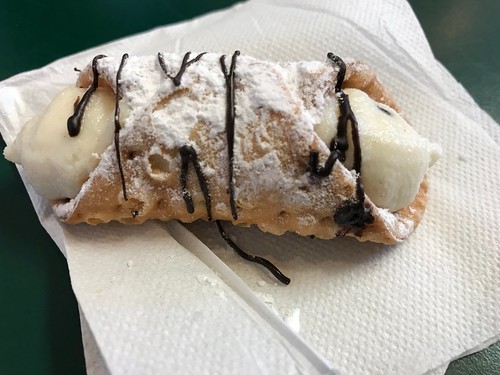
The tour starts, oddly enough, at a dessert shop. We all sampled classic Italian-style cannoli filled with ricotta cheese. It was rich enough I was glad I’d skipped breakfast.
Aside from food one stop includes a small sample of beer, another a small sample of coffee. Both were excellent. The cafe handed out extremely soft, melt-in-your-mouth pretzels. These didn’t go with the coffee at all but I’ve never had a pretzel like that so it’s hard to complain.
Another highlight of this tour was learning about the Old Market District’s history. One of the more unusual aspects was the addition of the “Passageway” seen in the above photo. This simple alley between two buildings was enclosed in glass and given a lush garden makeover.
In the Passageway today you can find restaurants, art galleries, etc. My favorite business in there was a tiny bookstore that’s also home to a small dog.
Hours after the tour I wandered back to the Old Market District at around 6 PM to see if it was any busier — and to find dinner. Sure enough the streets were significantly more crowded and the restaurants had opened. Still, all of the restaurants I peeked into had at least a couple empty tables.
My recommendation: Going in I had low expectations for a food tour in a small town like Omaha. But in all honesty the food was on par with what I’d expect to find in much larger cities. You can book this tour or any of the other Omaha Culinary Tours here.
Last night I arrived in Omaha for the weekend, but before delving into that here’s a few parts of the Chicago trip that didn’t fit anywhere else.
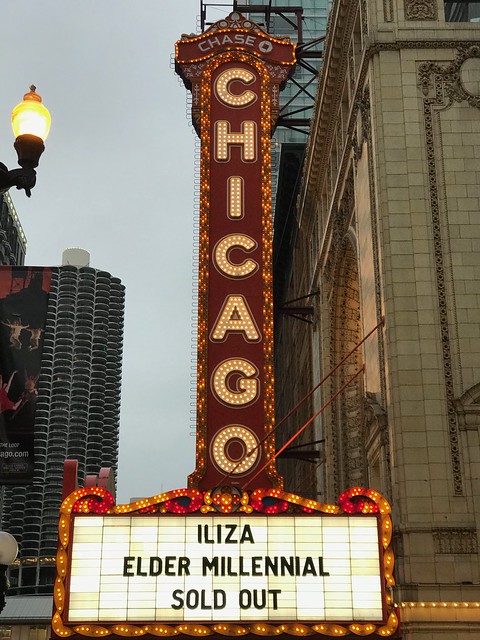
Yes, the Chicago Theater sign above is a landmark, and no I wasn’t the only person taking photos of it. The best place to get a clear shot of the sign is unfortunately from a narrow staircase leading up to the State and Lake “L” stop.
The biggest criticism I’ve heard of Chicago style pizza is that it’s more of a casserole than a pizza. It’s fitting then that the entire downtown area in Chicago is built like a casserole: on the bottom there’s a solid layer to insulate from the marsh the city’s built on; on the layer over that you have train and pedestrian subways and basements; next you have street level, and then finally you have buildings and the elevated “L” lines on top.
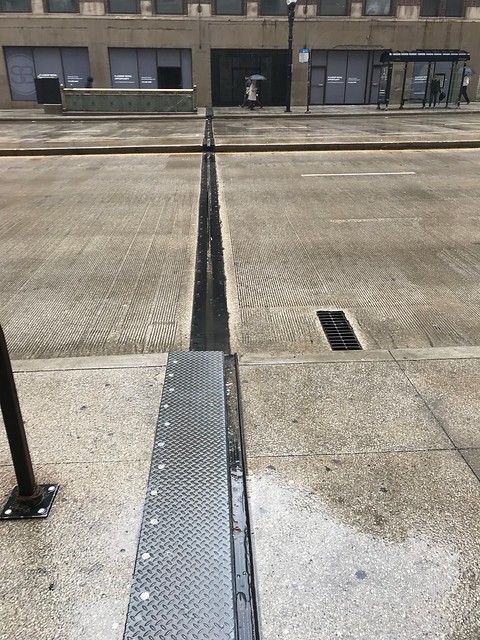
All of this is pretty obvious from certain locations along the Chicago river, but you also see expansion joints like in the photo above on what otherwise appear to be ground level streets. It seems odd until you realize you’re actually on a well hidden bridge.
In a lot of places in the world you’ll see “no smoking” signs on buildings; in Chicago, you see “no guns” signs instead.
I was especially surprised to see one of these signs on a Whole Foods. Who the hell brings a gun to a Whole Foods? Are they afraid of getting attacked by a bag of organic potatoes?
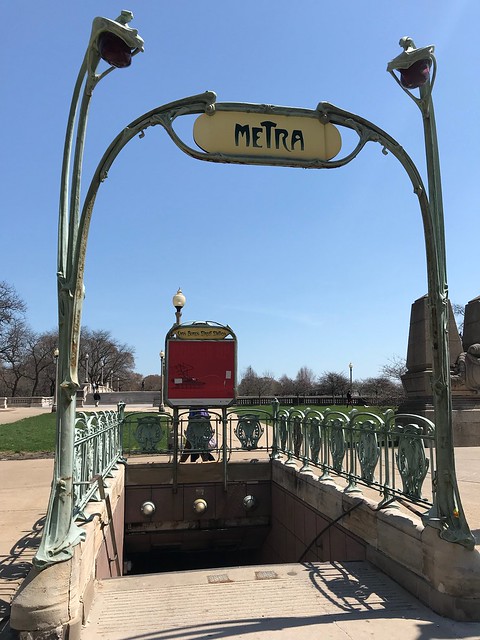
For the most part Chicago’s Metra stations appear unremarkable, but there’s exactly one station entrance that seems… out of place? In fact it was a gift from one of Chicago’s sister cities: Paris. It’s a careful reproduction of the classic Paris Metro station entrances.
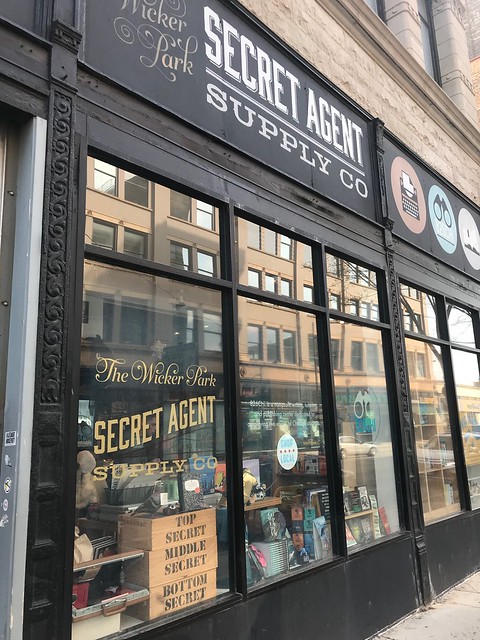
I completely blew my cover by visiting the Secret Agent Supply Co. store. This is run by 826, the youth writing workshop founded by Dave Eggers, which is also behind the Pirate Store in San Francisco and the Time Travel Mart in Los Angeles.
They sell a variety of disguises and books, including books on writing and books from new Chicago authors. It’s a little out of the way and a very low key operation.
Parts of the Chicago River have a pedestrian walkway known as the Riverwalk. There’s a few restaurants and bars down there, and it’s a nice place to walk without ever having to encounter automobile traffic.
The Riverwalk isn’t complete yet though, some parts don’t connect and others are still under construction. It should be a lovely spot to take a walk or jog when it’s done but even the currently open segments are worth checking out.
The 606 is a pedestrian and bike path that’s partially elevated, built on a defunct rail line. I discovered this one completely by accident. It’s by far the most bicycle-friendly part of Chicago.
There is an irony of the 606 though: the defunct rail line used to serve the Schwinn Bicycle Company back when they still made bikes in Chicago.
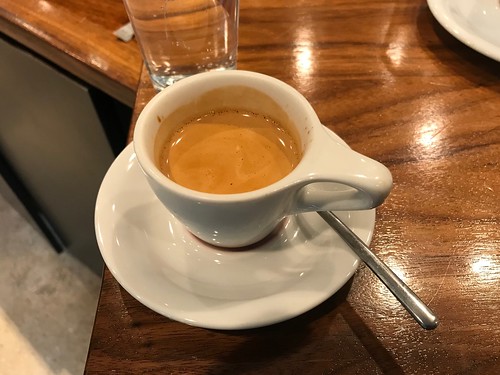
Before heading to Union Station on my last day in Chicago I knew I had to try the espresso at Intelligentsia Coffee. I kept putting it off because the lines were intimidatingly long, but I’m happy to report it was worth the wait.
That’s it for Chicago! Next time I’ll have a post or two about my 48 hours in Omaha.
The easiest and most cost effective way of traveling in Chicago when walking isn’t practical is taking the “L” trains. They’re called the “L” because they’re elevated… except a few of the stops are actually underground. (Adding to the confusion, the regional Metra rail network also runs on elevated tracks in certain places.)
Each “L” train has a color and a destination. Your best bet for finding your way around is Google Maps — not only does it tell you where to get on and off, it provides up to the minute notifications of delays.
The “L” is run by CTA, which also runs the local buses in Chicago. Personally I never used their buses but depending where you’re going it may make more sense.
Both the “L” and the CTA buses take the reusable Ventra card which you can buy for $5 at any CTA ticket vending machine. If you register the card online you get your money back in $5 worth of transit credit on the card.
You can either pay per trip or buy one of several day/multi-day pass options with unlimited rides. These passes are surprisingly inexpensive, particularly if you compare the cost to Uber or a taxi.
If you’re not interested in buying day passes I’m told you can also pay with your phone if you have a phone that supports Apple or Android Pay. In practice I didn’t try this or see anyone else pay this way either.
Not as complicated as it looks, I promise
Tourists should note that the “L” goes to both Midway and O’Hare airports. It doesn’t go directly to Amtrak’s Union Station but there is an “L” stop a short walk away.
Do be aware that the above ground “L” lines can be very loud — not so much inside the train but outside. You’ll definitely hear when they’re going over, particularly on drawbridges or around corners. This is something to consider when you’re looking for a place to stay or at the very least whether or not to bring earplugs.
The “L” is such a defining feature of downtown Chicago that the neighborhood is called “The Loop” because of the circular above ground track loop. Additionally, both the red and blue lines go underground within The Loop.
One unusual feature of above ground rail in a city filled with high rise buildings is you can often see right inside the buildings. I’m sure nobody would appreciate it if you brought binoculars to spy on office workers while waiting for your train.
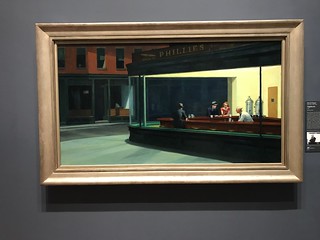
One block south of Millennium Park is a stately looking building housing the Art Institute of Chicago, an art museum with a vast collection of pieces from all over the world. From the street you might think it’s a small museum, but you’d be wrong. The building visible from the street is largely a facade; the majority of the galleries are in a sprawling complex of wings on the other side of the train tracks behind the entry building.
Broadly the museum is broken down into Asian, classic (Greek and Roman), European, American, and contemporary. That’s not a comprehensive list but it gives you an idea of the scope. I have to admit that due to the convoluted layout of the place I’m not sure exactly how much I was able to see.
The sheer size of the museum is both a blessing and a curse, like an enormous yard sale where there’s some rare book on a table surrounded by broken Cuisinarts.
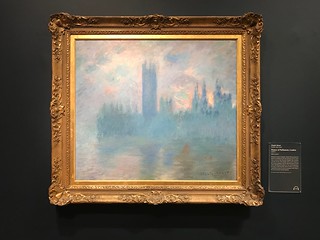
For example one room had a bunch of paintings by Monet that for some reason devoted an entire wall to paintings of haystacks. Then I turned a corner and found myself face to face with a small yet beautiful self portrait of Van Gogh.
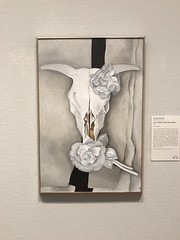
The biggest strength of the museum is how it can expose you to styles of art you’re unlikely to have ever seen before. On the flip side its biggest weakness is displays of art from the Art Institute’s associated school. Don’t get me wrong, they have some fantastic staff and alumni — just their collection of Georgia O’Keeffe paintings alone would be considered a special exhibit at any other museum — but overall the selection of works from their own school seemed sloppy and haphazard. This part of the museum would benefit from a neutral third party curator much in the same way doctors aren’t supposed to treat themselves.
The audio guide tour can be rented or like many museums these days you can also get it for free simply by downloading the Art Institute’s app on your phone and bringing your own headphones. Only one or two works in each gallery have an audio guide component and those that do are always the highlights.
My recommendation: If you’re in Chicago and you’re at all into art, there’s almost certainly something you’ll enjoy at this museum. Perfect indoor activity for a day with uncooperative weather.
Originally built as a second home for the wealthy east coast Nickerson family, today the Driehaus Museum focuses on home life in the Gilded Age of America. I realize that’s a lot of description crammed into one sentence so let’s break it down.
Sam Nickerson and his wife built their Chicago mansion about a decade after the Great Chicago Fire. As such it’s built with solid brick walls. The interior is lined with pretty much every material you can think of; many types of wood, tile, fabric, and even a precursor to linoleum.
When the Nickersons decided to move away, they sold their home at a steep discount to a friend. It eventually was converted into offices, and was most recently purchased by a different wealthy Chicago man, investor Richard Driehaus. Hence the name of the museum.
In the early 2000’s Driehaus had the property restored as much as possible to its original glory, with a mix of original furniture and period-appropriate furnishings from his own collection. Throughout the home you’ll find everything from Tiffany lamps to (seemingly decorative) office supplies.
Additionally you’ll see special exhibits, which currently include a small exhibit about the 1893 Chicago World’s Fair, and a much larger exhibit throughout the museum by British-Nigerian artist Yinka Shonibare which broadly reinterprets elements of the era ranging from colonialism to Oscar Wilde. These will change in the future so check the museum’s website for up to date information on current exhibits.
My recommendation: Such an eclectic museum seems like it should be an off the beaten path find, and yet it’s located on Chicago’s Magnificent Mile. If it sounds interesting I’d start by booking the hour long guided highlights tour and going from there — the tour includes general admission. Coat and bag check is free.
In Chicago I took a few tours that were highly recommended online. There’s something said for the wisdom of the crowds, these are all solid tours I enjoyed and would recommend as well if the subject matter interests you.
Second City Classic Food Tour from Chicago Food Planet
My first tour in Chicago was this “classic” food tour which focuses on various cuisines you can readily find in Chicago. I don’t think it’s a spoiler to say that yes, Chicago deep dish pizza is included — and it’s the first stop.
I’ve had deep dish pizza before (I mean, who hasn’t?) but this one was above and beyond anything I’d ever tried. As the only non-meat eater in the group I got a small pizza all to myself instead of “just” a big slice with sausage. Even though I arrived hungry I couldn’t finish the entire thing, it was too big and too rich. The most amazing part wasn’t the crust or the cheese — it was the crushed sweet tomatoes on top instead of a traditional sauce. Everyone had the same tomato topping.
The other stops on the tour included a mix of local and international food, beverages, ingredients, and a classic local bar and BBQ joint. Since I don’t eat meat I can only vouch for the homemade BBQ sauce.
The architectural component of the tour was cut short because, well, it was snowing. On the bright side we also had a more intimate experience due to several last minute cancellations.
Chicago Architecture Cruise from Chicago Line Cruises
With many architecture cruises and walks to choose from, I went with this one not only because of recommendations, but because it’s the most comprehensive.
The tricky part is figuring out where this tour starts; you’ll probably pass by similar tours on the way there. Just keep an eye out for the cruise company logo and take your phone’s directions with a grain of salt — location services can be a little wonky with tall steel structures around you.
The tour guide lectures at a fast pace on the architecture along the Chicago river. You’ll learn how architects think about integrating buildings into their surrounding environment as well as how they work around the unique challenges of building on the river, and in some cases the existing rail infrastructure underneath the new structures.
Another common theme is how modern developers adapt and reuse existing buildings that were originally built for, say, a Montgomery Ward order fulfillment warehouse.
Complimentary soft beverages, coffee, and snacks are available on the lower deck. Beer and wine are available for an extra charge.
Dress warm for this one, the Chicago river is significantly cooler than the city above.
If you keep up with the news at all it’s no secret that Chicago has a problem with violent crime. (Side note: crime isn’t a major concern for most tourists.) This walking tour focuses on Chicago’s dark past as well as places that are allegedly still haunted by it.
Without spoiling anything major, here are a few key points of the tour:
The life and death of notorious mob boss Al Capone
A mass tragedy that led to certain modern day fire codes
How the mafia used Chicago’s infrastructure to hide the sound of gunshots
The story of America’s first serial killer
It’s a fairly long tour; about two hours with a lot of walking and some stairs. There’s a bathroom break partway through so I’d recommend bringing water. The guide didn’t pull out any gory photos or anything though the descriptions were graphic enough that the younger or more squeamish guests might want to steer clear.
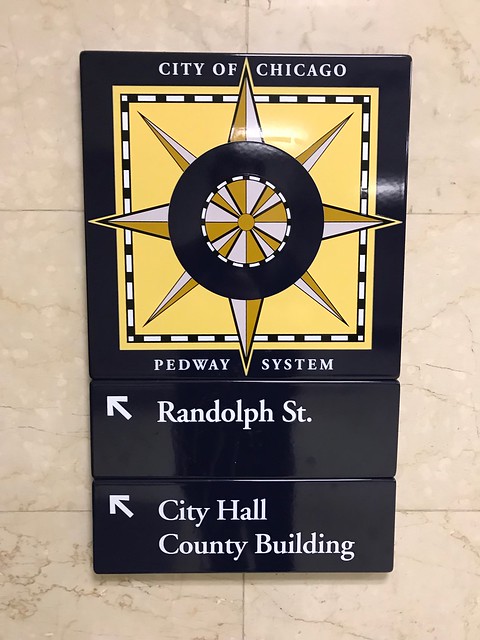
Did you know Chicago has series of ad-hoc underground public walkways known as the “pedway”? This hour long tour takes you through a few of them, connecting government buildings, malls, three train stations, and more.
It’s the perfect indoor walking tour for a day when the weather’s not so great. The tunnels aren’t at a consistent level and some are better cared for than others. Weirder yet, not all of them even appear on any (semi) official map.
It’d be super easy for us tourists to get lost down there without a guided tour. Fortunately the tour guide, Margaret, is an incredibly warm and passionate person who knows her way around and loves sharing her knowledge.
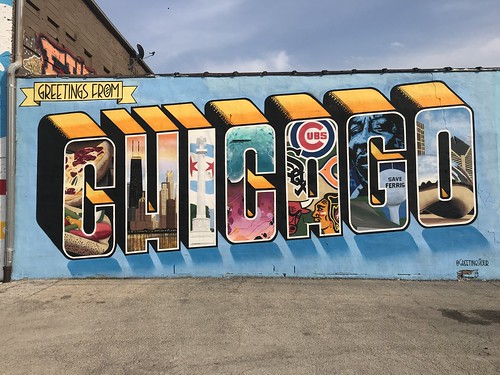
The most famous street art mural in Logan Square, if not all of Chicago
I almost skipped making a visit to Logan Square; it looked so far away on a map. Turns out it’s a fast, if somewhat cramped ride on the “L” from where I’m staying, and there were a few other places I had in mind to visit in the area. So off I went.
And I’m glad I did. It’s a relatively small neighborhood in comparison to much of Chicago with a lot of local businesses, upscale cafes, and small restaurants. Walking through the area there’s a lot of people jogging, walking their dogs, or riding bikes. And yet if you wander off to a side street you’ll find dirt roads and auto shops. Perhaps it’s a neighborhood where people of all social classes live and work together, perhaps it’s a nightmare of gentrification — most likely it’s a little of both, but what do I know? I was just passing through.
What was clear about Logan Square is it’s got the most street art of any part of Chicago I’ve seen. Most notably, the much-photographed “Greetings From Chicago” mural seen above is located in the neighborhood. It’s only a couple blocks from the California stop on the Blue Line.
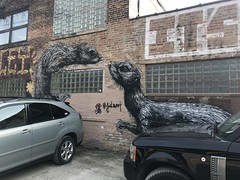
Here’s a handful of other street art I got a kick out of in the area:
Last but definitely not least is this enormous mural of the late Robin Williams and one of his most iconic characters, the genie from Aladdin:
Chicago’s enormous public downtown park on Lake Michigan is technically a collection of public parks. The newest one is Millennium Park which opened in the early 2000’s in order to cover up a sunken Metra train station.
Millennium Park features various modern tourist magnets, the most famous of which is colloquially known as “The Bean.” Technically it’s called “Cloud Gate,” but locals don’t call it that because, well, it looks like a big shiny bean. Let’s be honest here; the locals are right.
Many tourist guide books will point out that “The Bean” reflects the Chicago skyline. That’s true from a certain angle — but if you approach on foot you’ll quickly see that it’s like a big warped fun house mirror which reflects anything, including one’s own reflection.
If you want you can even walk directly under The Bean, and you’ll be in good company. This big weird sculpture is a popular selfie spot for the tourist crowd, intentional or not.
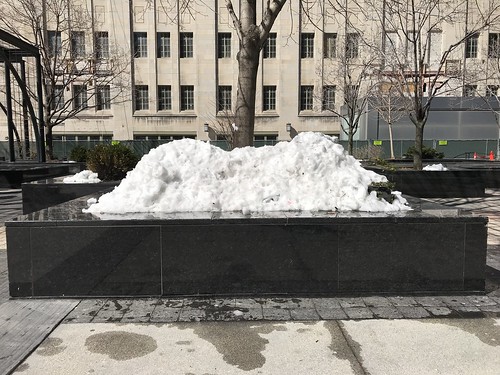
It’s a fun and free place to snap a photo and if we’re being honest it looks nothing like a cloud at all from any angle. Walking around the nearby just north of The Loop I happened to find the “real” cloud gate sculpture:
Okay, so that’s just a patch of snow that hadn’t melted yet. But you have to admit it looks much more like a cloud than The Bean does.
There’s also a big outdoor concert venue space in Millennium Park, an ice skating rink for winter months, as well as an art installation called Crown Fountain. You may have seen photos or videos of Crown Fountain which features two video screens facing one another displaying photos of faces that occasionally “spit” water at you. Unfortunately Crown Fountain was turned off during my visit.
On the east side of the park, a wavy bridge designed by Frank Gehry takes you over a highway to the kid-friendly Maggie Daley Park.
With millions of tourists flocking to see Millennium Park each year, every hip fast casual chain you can think of has an outpost nearby: Shake Shake, Protein Bar, Sweetgreen, Five Guys, etc. With Chicago’s combined ~10% sales tax combined with the fact that everything in Millennium Park has a corporate sponsor, this free attraction must be a gold mine for state and local governments.
My recommendation: It’s free, very easy to get to, and there’s a good chance you’ll be in the area while visiting Chicago. Why not stop by and take a selfie with The Bean? Everyone else is doing it.