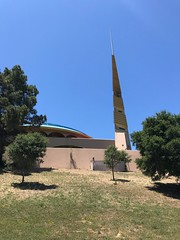
The more I’ve seen of Frank Lloyd Wright’s designs, the more I’m convinced he was an interior designer at heart who happened to get tasked with architecture. His interiors are always unique and playful, but the exteriors are almost offensively boring.
It’s certainly true of the Marin County Civic Center. From the outside it mostly looks like a big mess of arches, as though a bridge builder lost his or her mind.
Interiors
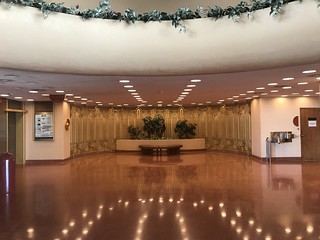
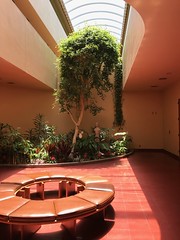
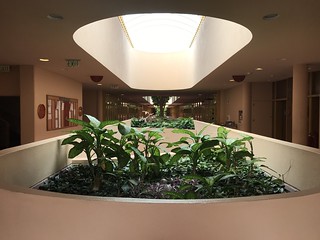
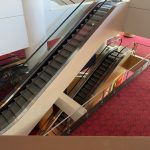
Stepping inside though it’s a completely different story; while it certainly has some of the look of a mid-century government building, the giant skylights and lush indoor gardens give off relaxing vibe. Pretty much the opposite of what most of us have come to expect from our interactions with government offices and courthouses.
I should point out that part of the secret to the building’s success is how well it’s maintained. It’d be much cheaper to let entropy take its toll and allow the gardens die or turn into weeds. Instead they’re watered, pruned, etc.
A number of tourists were wandering around in there snapping photos just as I was. Not much was going on since it was the day after July 4th, and the county fair was in full swing outside.
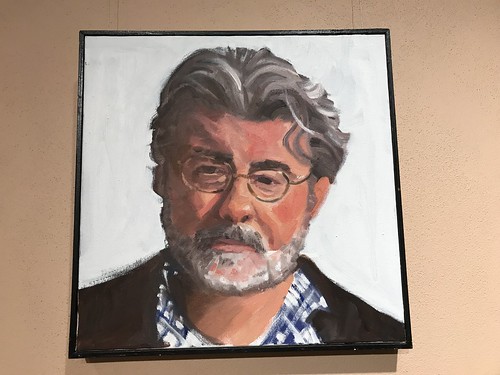
On my way out I walked through a gallery of painted portraits for sale. I recognized a couple of the people, but this one in particular seemed appropriate as he’s one of the more famous people in Marin County: George Lucas.
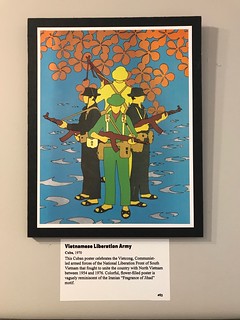
Housed in a former shoe store, each section of the museum is devoted to a certain type of propaganda. Examples include leader worship, promoting the military, and demonizing a perceived enemy.
It seemed to me a prevailing theme was the truth didn’t matter, as long as it got the message across. Are the farms failing? Start a rumor of an American covert operation! Is the leader of the country a war criminal? Here’s a photo of him smiling with some children!
One of the most surprising artifacts in the museum is a watch, part of a limited series given out to soldiers who participated in the Tiananmen Square massacre.
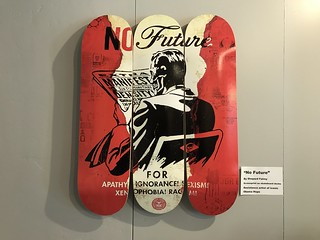
At the end of the main gallery, it switches to parodies of propaganda:
It’s interesting how the same imagery used to control the populace can be flipped on its head, now mocking the same authority it was once used to prop up.
The last area of the museum is a temporary gallery; it’s worth pointing out here the museum has only been around a couple years so temporary is relative. Right now it’s mostly about propaganda from the last presidential election to present day.
My recommendation: This is a very thought provoking museum, far more interesting than I would have expected. Definitely work a visit if you’re in the area and it happens to be open (the hours are very limited.) It’s free, though they do accept donations and ask you to sign the guestbook.
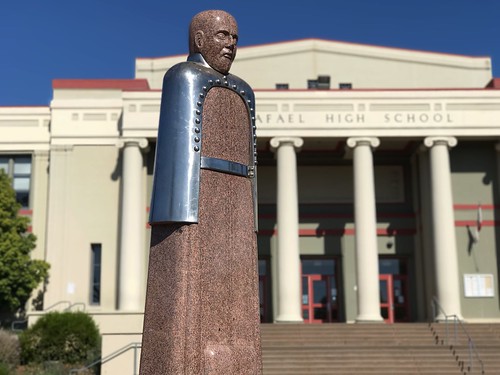
When I got off the bus from the Larkspur Ferry Terminal, I discovered I was a short walk from the origin of a well known slang term: 420, the not-so-secret code for marijuana. I had to go see it for myself.
As Atlas Obscura explains this unusual statue of Louis Pasteur in front of San Rafael High School was a meeting point for a group of students in the early 1970’s. These students met at the statue at 4:20 PM after school to head out and smoke marijuana.
The term 420 was somehow picked up by the band The Grateful Dead and it spread from there.
This got me wondering about something: how many hippie types with “420” t-shirts and such are anti-vaxxers who drink unpasteurized milk?
For the Forth of July weekend, I decided to split the difference between a real vacation and a “staycation,” opting to explore several parts of the North Bay I’ve never or rarely been to in the past.
My first stop is in San Rafael, named after the second to last of the Spanish missions in California: Mission San Rafael Arcangel.
The above photo is the current incarnation of this mission. Nothing stands of the original structures. I’m not entirely clear why they built something that’s clearly an architectural mashup between a modern church and the style of an early 19th century mission, especially since it just comes across looking ridiculous. But that’s what you’ll find if you walk a couple blocks up from downtown San Rafael trying to find the mission the city was named after.
To be fair the history of the mission is clearly posted in the front plaza, you can read the official story if you zoom in on this photo:
The term “gondola” can mean many different things. The first that comes to my mind are the boats in Venice, but here I’m talking about a different form of transportation: a gondola lift.
This gondola in particular takes visitors up from ground level to Salesforce Park on the top of the freshly re-opened Salesforce Transit Center. See it in action for yourself in my video above.
So far I’ve tried the gondola twice now to get up to the park since it re-opened on Monday. I was particularly interested in riding it since it wasn’t operational the first time Salesforce Transit Center opened.
While it’s interesting to try it out, it’s pretty silly. Here’s why:
You can only go up in the gondola: passengers are not allowed to ride back down in it. I assume this is due to space concerns at the top and bottom.
Unlike the elevators and escalators inside the building you can take to the park, the gondola takes at least three people to operate: one person at the bottom for crowd control, an on board operator, and a security guard at the top.
It reminded me of the time I took an inclinator (a diagonal elevator) when I was visiting Stockholm, which is to say it’s not that different from an elevator.
Both times I went on it there was a short line. I imagine it’ll be busier on the weekends, and should draw more of a crowd once buses are heading to Salesforce Transit Center again. It doesn’t seem like it would be worth waiting in a long line for since it’s hardly the only way up to the park.
On the other hand it’s a free attraction to a free park. Can’t complain about the price of admission.
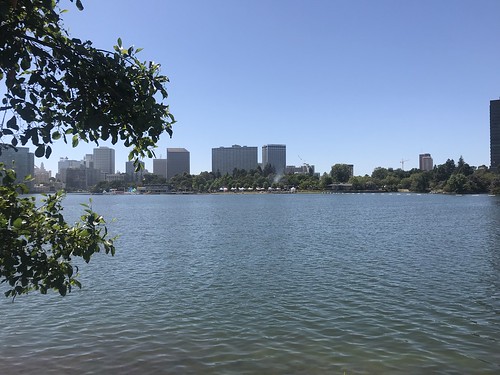
Today was Lakefest at Lake Merritt in Oakland. I’d never been to this festival before and decided to go take a look.
Lakefest is a free street festival outside the boat house at the north side of the lake. There’s your typical street food vendors, artists, and local businesses with booths. Walking over from the 19th St. BART station the first two booths I encountered were Oakland Police recruiters, followed by “The 90’s Experience,” which is apparently something like the Museum of Ice Cream. I couldn’t help but to chuckle when I noticed everyone promoting it was too young to have any nostalgia for the 90’s.
Wandering past all the food vendors I spotted another area behind them that wasn’t at all obvious how to get to. I snuck between a couple of food trucks and found a large booth selling Bud Light. I was about to turn away until I noticed they also had a frozen margarita machine. Wasn’t the best margarita, but given the heat I was happy to part with ten dollars and suffer from brain freeze to cool down a little in the hot weather.
At the other end of Lakefest were some kid friendly activities like carnival games, a little “train” ride, and an inflatable slide thing. These attractions had a shared ticket booth.
Lower down towards the lake was another area with a music stage set up, a second Bud Light/margarita bar, and various clothing vendors. If you wanted any type of t-shirt with “510” or some variation of the Oakland city logo, that was the place to get one.
In some places the event was listed as the “2nd Annual” Lakefest, which isn’t exactly true since there was a similar festival at Lake Merritt of the same name back in 2008 and 2009. While I wasn’t there, my understanding is it was at a different location. Further back in time there was an annual event called Festival at the Lake in the 80’s and 90’s.
It’s worth pointing out that Lake Merritt began attracting increased attention two years ago when the racist “BBQ Becky” incident made national news, and quickly became an internet meme. Whether that incident spurred the organizers to resurrect Lakefest or it was just a coincidence, it’s a great example of the old saying about making lemonade when life gives you lemons.
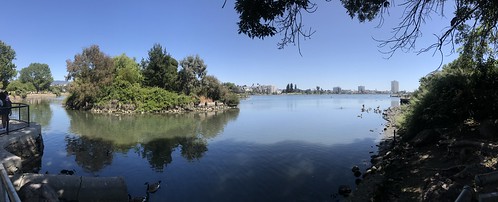
After leaving Lakefest I went for a walk around the lake. It was easily the busiest I’d ever seen it. Aside from the usual joggers and the drum circle that’s somehow always under the pergola, there seemed to be a record number of picnics taking place around Lake Merritt — including plenty of black picnickers with BBQ grills.
My recommendation: I don’t know if they’ll do Lakefest again next year, but if you live in the area or want an excuse to visit Lake Merritt it’s worth checking out. There’s something for kids and adults alike at Lakefest, but of course the same can be said of Lake Merritt itself.
The space at 2223 Market Street has seen many restaurants come and go over the years, including the memorably named 2223. These days it’s home to Izakaya Sushi Ran, a Japanese gastropub (no, I’m not exactly sure what that means either.)
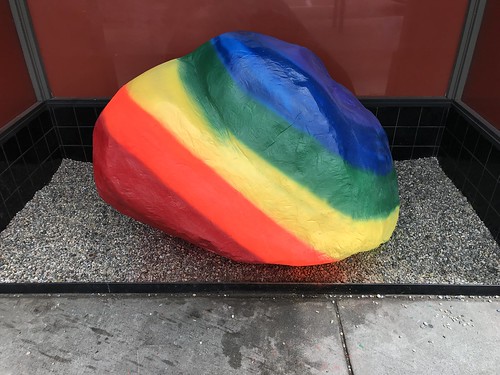
The new restaurateurs placed a large rock — if not a small boulder — outside a window facing Market Street where there’s an overhang. Presumably this was to prevent homeless people from sleeping there, or it could be some strange experiment in collecting dog urine.
To celebrate the upcoming San Francisco Pride weekend, the restaurant owners had the rock painted in the distinct pattern of the LGBT rainbow flag.
Photo by Max Canon
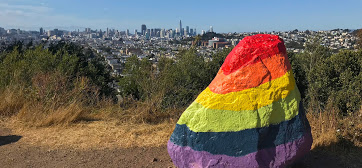
Which got me thinking… there’s another, much more famous rock in the city that was recently painted with the rainbow flag.
The Bernal Boulder in Bernal Heights Park has been painted numerous times over the years, taking on identities from a slice of watermelon, to candy corn, and perhaps most memorably as a poop emoji. Around this time last year as seen above, it was painted in the colors of the rainbow flag.
Are “pride rocks” a thing now? are two instances enough to make something a trend? I don’t know, but something tells me this isn’t the last time we’ll see a rock painted like a rainbow for Pride.
A few months ago a building at the corner of Dolores and 18th Street started a somewhat belated seismic retrofit, which meant the temporary closure of its two ground floor tenants: hip Korean restaurant Namu Gaji and the ever popular Bi-Rite Creamery.
Bi-Rite Creamery never closed entirely, instead operating out of a food truck parked right outside until they recently reopened their indoor ice cream parlor. Fans of Namu Gaji are still waiting for it to reopen, or have been heading over to its sister restaurant Namu Stonepot on Divisadero.
Today I wandered by to find the Namu Gaji space is preparing to reopen with a colorful new paint job. According to their Instagram page it’s the work of Namu Gaji’s own @danseung and @maliciouslee, along with local muralist @rys78.
Visually it’s the biggest change to that corner since Dolores Park’s renovation. Namu Gaji itself largely retained the dark gray-ish exterior it inherited from that one woman’s boutique it replaced many years ago.
When it reopens Namu Gaji will rejoin the 18th Street “gourmet ghetto” including Delfina and its sister pizzeria, Tartine Bakery, Bi-Rite (both the grocery/deli and creamery), and Dolores Park Cafe — and soon a new offshoot of Al’s Place.
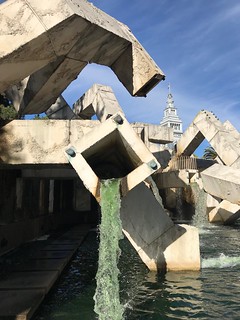
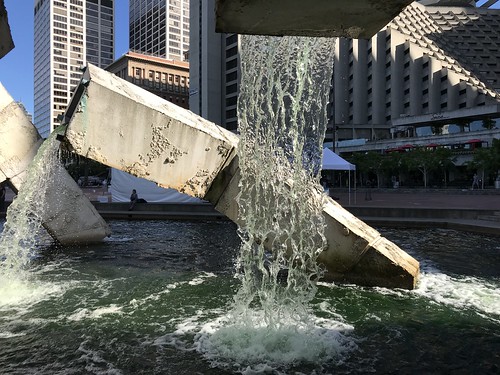
Of all the controversial elements of San Francisco, Vaillancourt Fountain easily evokes the strongest love-it-or-hate-it response of any water feature. Sitting in the corner of Embarcadero Plaza (formerly Justin Herman Plaza) it looks like a large knot of rectangular pipes spewing water in various directions — when it’s on, that is.
Over the past couple decades the fountain hasn’t always been running, but was turned back on three years ago and has mostly been running since then.
Many critics today point out that the fountain fit the area better when it was in the shadow of the similarly Brutalist architecture of the Embarcadero Freeway. They have a point. Aside from the visual style, the fountain’s pump moves water at a blistering pace, creating a loud soundscape of splashing water that could easily down out the sound of the freeway that once stood behind it.
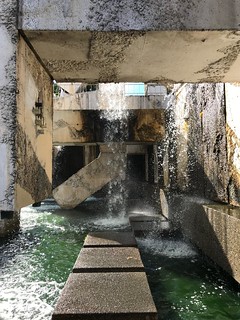
Unusually for a fountain there’s a walkway through it on a number of concrete slabs. This seems to be a major attraction for kids, but be warned it’s always slippery and you’ll likely get wet walking through it. Also note there’s no handrails so be careful down there.
It’s certainly worth taking a chance on the walkway if you’re up for it, the view from there is completely unique.
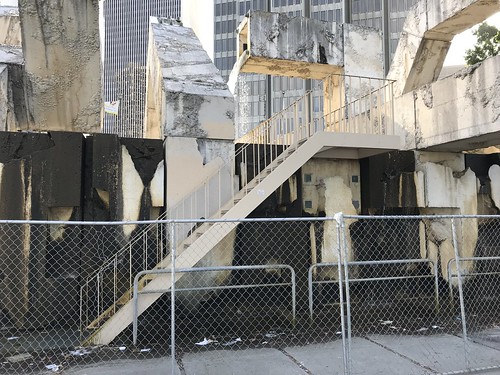
At some point in recent years the back of the fountain was fenced off. This is unfortunate; two staircases behind the fountain lead to overlook points facing toward the Embarcadero Center (and away from the former Embarcadero Freeway) which was a nice spot to take photos if nothing else. Perhaps there’s a safety concern, but then again these stairs and overlooks always seemed safer to me than walking through the fountain down below.
For some reason the fountain is operated by the city’s Recreation & Parks Department despite being located on private property — it’s part of the Embarcadero Center office/retail complex. This arrangement gives the fountain some protection against critics who want to see it demolished.
I will say this: critics of the fountain only seem to crop up when it’s not running. There’s a lesson here about public art. If it’s going to be successful in the long run it needs a maintenance budget. Pretty much everyone appreciates the idea of public art, but when it’s sitting there broken it’s not going to win over any new fans.
I’ve been meaning to conclude my first two blog posts about Nonchalance’s The Latitude (part one, part two) with a final wrap up since 2016, and yet somehow I never quite knew what I wanted to say. Tonight, I finally have an excuse to get all my thoughts written down once and for all — because there’s now a film about The Latitude.
Earlier tonight I went to the first public screening of In Bright Axiom, a documentary(ish) film chronicling the rise and fall of The Latitude. The film is directed by Spencer McCall, who was also the director of The Institute — a similar “documentary” about Nonchalance’s previous project, The Jejune Institute.
I went to the theater not quite knowing if it would be ex-members, or just people interested in watching documentaries since it was presented as part of SF DocFest. It turned out to be a mix of both, a suspicion confirmed right away when I saw a guy sitting a few seats down from me wearing a Jejune Institute t-shirt.
Before the film started, a DocFest presenter came to the stage and introduced The Professor (Geordie Aitken) who came up to the front and warmed up the crowd with some jokes. He’s remarkably good at working crowds.
Unlike The Institute, McCall went with a more straightforward documentary style for In Bright Axiom. Even though it takes an artistic license here and there for the most part it presents (as far as I know) events as they really happened. The major exception is a pretty obvious one, which finally gives the story of The Latitude a proper ending.
I don’t want to give too many spoilers away as it’s a wonderful film, but here’s a few key insights:
The Latitude initially held retreat(s?) in Mendocino out in the woods with a series of rituals, artists, and characters.
Nonchalance head honcho Jeff Hull confirms a number of aspects that were widely rumored — he’s independently wealthy and (if you do some basic multiplication) was spending about a million dollars a year to run The Latitude.
Much of the screen time goes into why The Latitude fell apart. The relationship between the creators and the participants deteriorated pretty rapidly, particularly when members were asked to pay to support it.
The question on my mind is who should see the film. Certainly anyone who took the time to read about it — whether on my blog or anywhere else — should give it a watch. The videos of The Latitude’s incredibly well designed spaces do them much more justice than static photos and descriptions ever could.
I also think creative types who are interested in immersive design should give it a watch. It’s a cautionary tale about how this type of art can become a victim of its own success when the boundaries are ill-defined. The irony of this failure when The Latitude’s internal story was all about breaking down boundaries was not lost on anyone, at least in retrospect.
The film ends with a mysterious logo appearing on the screen. What does it mean? Well, The Institute ended with the logo for The Latitude… wink, wink.
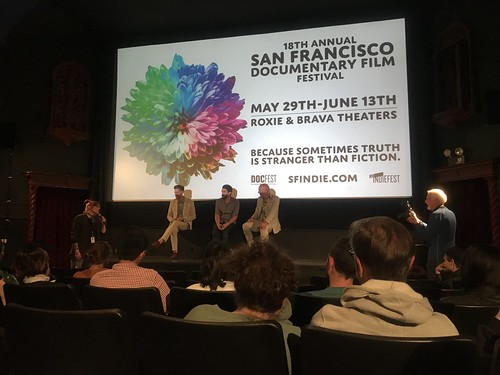
After the film there was a Q&A session with three of the people behind it, seen in the photo above. On stage from left to right there’s Geordie Aitken who played Professor Walter Kinley, director Spencer McCall, and Jeff Hull.
I had a few questions, though I never got to ask them because others beat me to the punch. I did sort of want to make an in-joke and ask Geordie if he was going to force us all to make tea, but I worried that would be too obscure. (For the record, Geordie played the poorly received Antoine Logan of the Jejune Institute in its final seminar, and he wanted us to make tea.)
One question aimed at Geordie was how he became involved in Nonchalance in the first place. He said he read about The Jejune Institute on a blog, and became so fascinated he talked Jeff into letting him take part.
Looking back, I remember after The Jejune Institute ended a bunch of us went up to Jeff, sort of ganged up on him really, and asked questions about what was next. He sheepishly mentioned he was working on an “automated house” of sorts, and that it “came to him in a dream.” In retrospect it’s obvious the “automated house” was The Latitude’s Book One, and his dream ultimately became a waking nightmare.
Though I don’t remember the question, in the Q&A it was brought up that The Jejune Institute’s designer Sara Thacher is now an Imagineer at Disney, and was most recently involved in creating the new Star Wars: Galaxy’s Edge land at both Disneyland and Disney World.
The Latitude’s Online Presence
Getting in to some other aspects of The Latitude I haven’t covered yet in previous posts, let’s talk about the user-facing interactions. Despite the somewhat anti-technology bent to the whole endeavor, the primary way to interact with The Latitude was online.
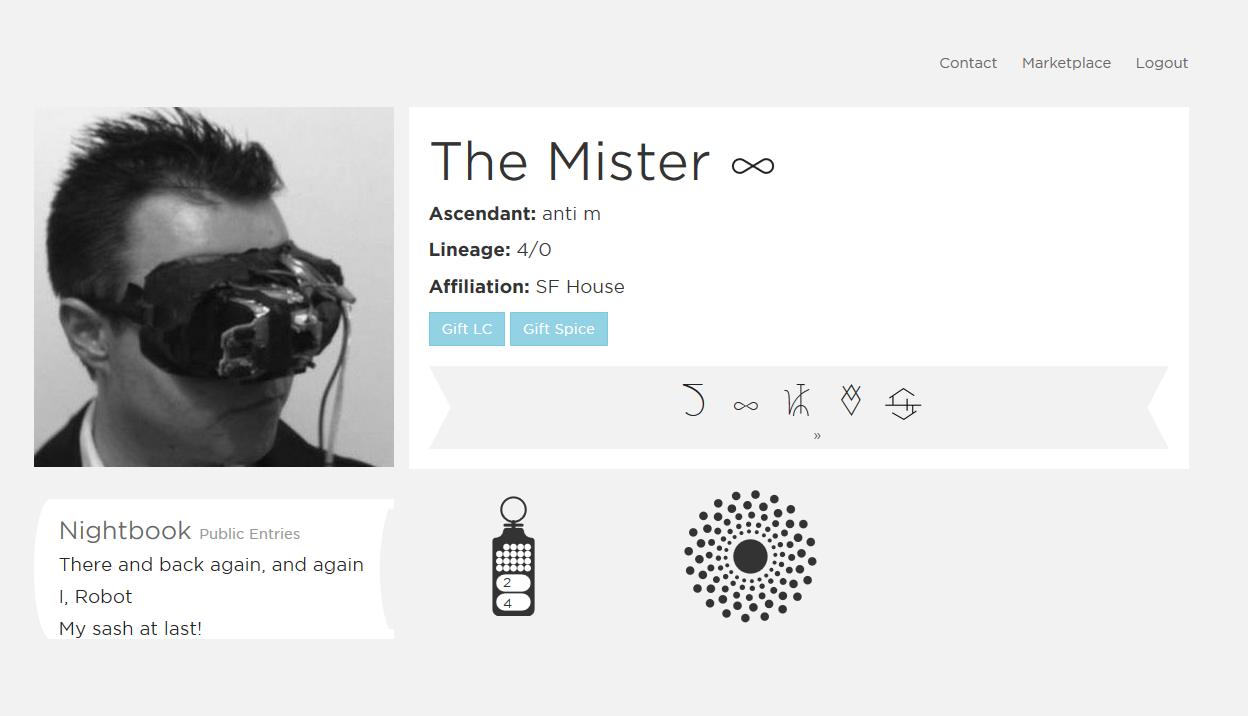
The website was kind of like a social network with a unique focus on sharing blog posts and earning badges for completing tasks. Here’s a screenshot of my profile page during the final stages of the site before it was taken down.
My username was “The Mister,” a reference to both the name “MrEricSir” and a humble riff on Doctor Who character “The Master.” The URL to my profile page was https://thelatitude.com/HEXA-AZURE-4280, with HEXA-AZURE-4280 being the “index code” on the back of my invitation card.
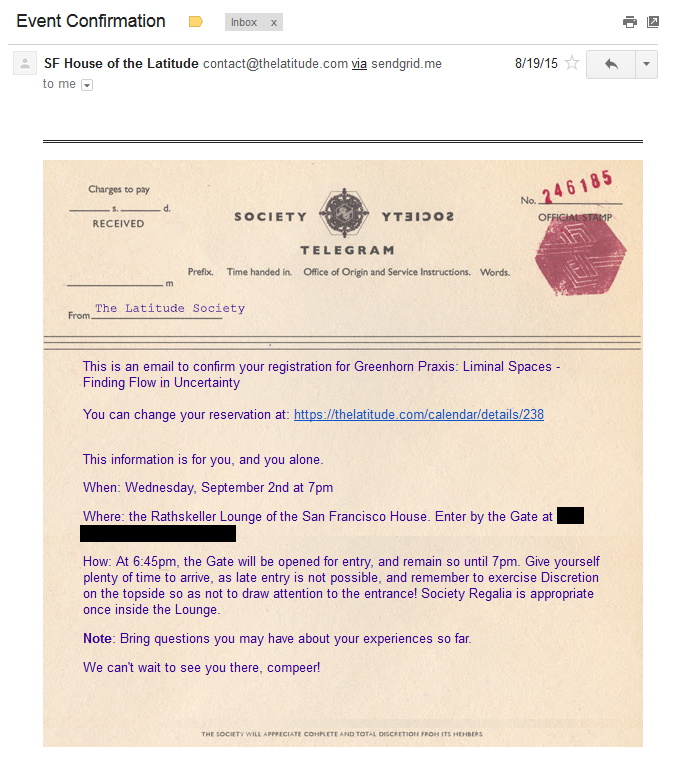
Emails from The Latitude always had a unique design as though they were a confidential telegram sent on special paper. Here are couple examples:
Praxes
The Latitude’s website had a calendar with many events throughout the week known as “Praxes” (plural of Praxis) which ranged from the introductory Greenhorn Praxis, members gathering for brunch, watching Saturday morning cartoons, etc.
My favorite of the praxes I attended was a workshop to build your own terrarium. Cosmic Amanda, best known as the creator of local online radio station BFF.fm, hosted the workshop. I’m proud to say one of the terrariums I built is still intact.
There never seemed to be much direct connection between The Latitude and most praxis events; it was more of a loosely connected social club where members could meet one another. Some were held in private spaces, others in public.
Closing Thoughts
If it’s not obvious enjoyed The Latitude and was sad to see it go. For my part I only joined months before the end so I was largely unaware of the internal drama that came before my time.
That said, the entire project seemed insanely ambitious. Nonchalance was renting numerous spaces in one of the most expensive cities in the world, telling a complex story, all while trying to keep a veil between themselves and the members of the (fake?) secret society they created.
The tipping point seemed to be asking for money. On one hand the membership fee wasn’t a lot for most people, on the other some members were obviously contributing a great deal of time and energy already. Perhaps there should have been a sliding scale aspect to the membership fees.
It’s also worth remembering this all took place in a part of the world where the economy is weirdly distorted: people spend $1,000 a month to live with roommates, yet eat food or take Uber rides that are heavily subsidized by venture capital — often without realizing it. Point is in the Bay Area we’ve all been conditioned to have very unrealistic ideas about cost.
On the flip side The Latitude “competed” in a way with a similar immersive experience run entirely by volunteers: Elsewhere Philatelic Society (EPS.) It wasn’t uncommon to see members of The Latitude with EPS patches sewn onto their jackets. Ironically, EPS was initially a fan-made offshoot of The Jejune Institute. With significantly lower overhead, EPS outlasted both The Jejune Institute and The Latitude, and is still around today. I think there’s a lesson here about creating these types of immersive art projects that can have a similar impact on the audience while spending far, far less money.
As what’s next for Nonchalance, they are once again working on a new project — what is it? We’ll just have to wait and see.
Until next time, in bright axiom; compeers and dark horses alike.