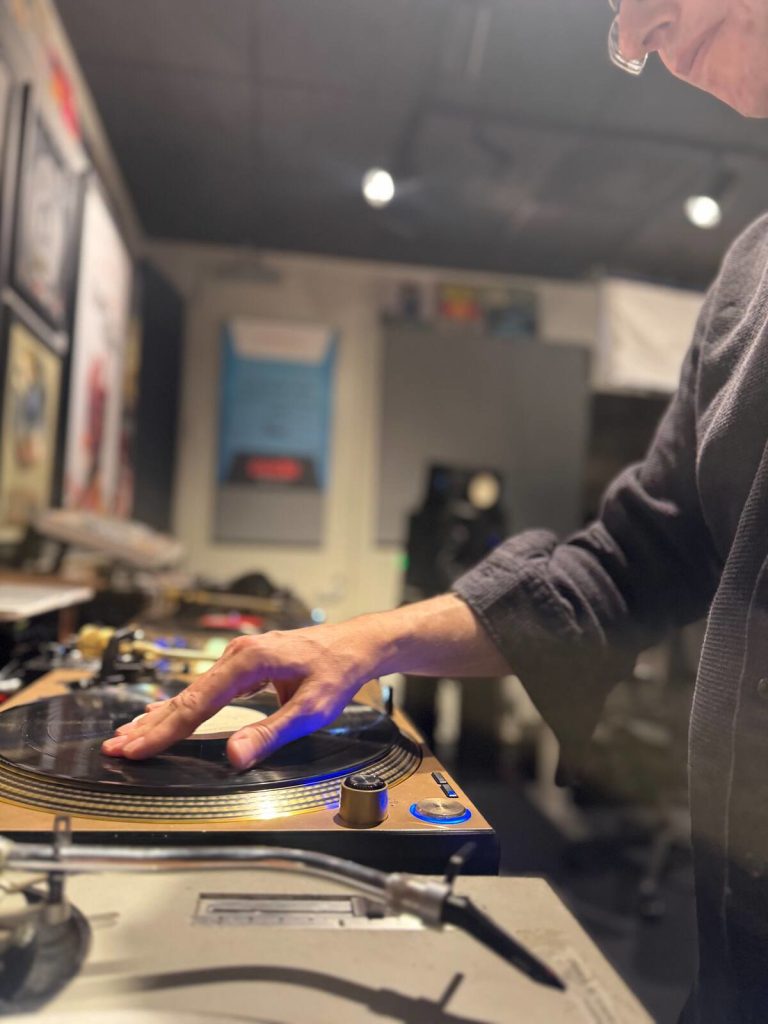
Departing Long Beach for the more lively pace of central LA, I found myself on the Sony Pictures Studios campus in Culver City. There I met movie industry music supervisor, DJ, and self-described music nerd Burt Blackarach. His studio space is packed with floor-to-ceiling shelves of records, along with several desks topped with turntables and audio workstations.
I lucked out reserving his Be a DJ For A Day class when I was the only student, so Burt gave me his undivided attention with a custom-tailored lesson.
As a “geriatric millennial” who grew up around records, I was already comfortable with basic record handling techniques, how to read the visual cues imprinted on the vinyl, and of course how to actually play a record. I was somewhat rusty but got into the groove (sorry) pretty quickly. Though I’d never worked with a professional-grade turntable before, the basics are similar. The component quality and fine-grained controls are what make the difference.
We moved on to carefully dropping the needle into the silence between songs, then worked our way up to tricks like manually rewinding/fast forwarding and scratching.
I should point out that these DJ techniques damage the records over time, so you wouldn’t want to do these with vinyl that you don’t own or have permission to use.
Exactly what’s covered in this course will depend on your skill level and interest, but here are a few interesting pointers I picked up:
- Scratching is a real craft. It’s trickier than it looks and would take quite a bit of practice to get it right consistently.
- DJs have their own secret records. These feature premade sample loops with visual indicators, useful for mixing between songs.
- Modern technology has its trade-offs. The digital control surfaces that mimic record decks vary in price and quality quite a bit, but the basic motions are the same as analog decks. The main benefit is that with fewer moving parts and no physical media, they’re much easier to pack for travel.
- Timecode vinyl is a special type of hybrid record. These bridge the gap between the analog and digital worlds by playing a continous control code — think like a dial tone sound — which DJ software can pick up. This lets you use analog decks to play digital audio as though it were on a vinyl record.
All things considered, I had a lot of fun with this one as I walked in with zero experience and walked out with key tactile skills and basic knowledge. The time flew by incredibly fast.
My recommendation: If you’re curious about learning to DJ, there are plenty of options out there, from IRL to online, from introductory to advanced. This is a great starting point if you’re in the Los Angeles area because Burt is both a professional DJ and a fun, relatable instructor — especially if you want to learn to spin vinyl.